
Shelby Township City Directory Collections
Shelby Township is a charter township in Macomb County. Mount Clemens is the county seat. It is also the main local-history hub for the area. The Mount Clemens City Directory Master Index is the strongest named run. It covers 1896 through 1966. Use it to secure a name, an address, and a year. Request the matching volume or page after that. The index is not a complete set of digitized pages. A hit does not prove the volume covers Shelby Township. Check the source page for the township label, address, and date.
| Collection | Years | Where held | How to use it |
|---|---|---|---|
| Mount Clemens master index | 1896-1966 | Mount Clemens Public Library | Online index, then request the matching volume or page |
| Macomb County Directory comparison volume | 1949-1950 | County-hosted PDF | Inspect contents and pages for Shelby Township coverage |
| Macomb County Directory comparison volume | 1965-1966 | County-hosted PDF | Check the actual page, not only a search result |
| Shelby Township rolls | 1875-1920 | Heritage Alliance collection lead | Ask the holding institution about the original roll or related file |
| Shelby maps and county plats | 1904, 1944; 1875, 1895, 1916 | Library, Heritage Alliance, or archives leads | Use with a legal description or older road name |
The two county PDFs serve as comparison sources. They promise no continuous township coverage. Search their tables of contents and indexes, then inspect every promising page for a Shelby entry. Record the title, volume years, and page. Note the printed spelling, address, and any household or business label. That level of citation lets you revisit a result whenever a scan or OCR reading is unclear.
Microfilm matters here. The Mount Clemens Public Library Local History and Genealogy Room supplies the main shelf-and-reel route for this work.

The room's cataloged local material offers the next step. It moves a Shelby Township lookup from an index reference into the original printed context.
Shelby Township Local History Room Access
The library describes its Local History and Genealogy Room holdings as more than 300,000 print volumes. Microfilm tops 5,000 reels. Subscriptions and locally made indexes round out the collection. Posted hours are Monday, Tuesday, and Thursday from 10 a.m. to 6 p.m. Wednesday runs noon to 6 p.m. Friday is 10 a.m. to 5 p.m., and Saturday is by appointment. Reference help sits at 586-469-6200 ext. 6. Check availability before a special trip, since a needed volume, reel, or scanner may not be free.
Start with the master index. When it supplies a lead, contact the room. Or work from the held volume or microfilm. A dated newspaper item beside a directory entry often explains why a family appeared on a given street that year, and the room's local microfilm can supply the contemporaneous notice or advertisement. The Library of Michigan newspaper holdings guide is another route for locating microfilm and arranging interlibrary-loan research when a title sits elsewhere.
Note: A library index points to a source, not a substitute for reading the dated page or microfilm image.
Shelby Township Master Index Leads
The Mount Clemens City Directory Master Index is the best online starting point. It serves a historical name-and-year question well. Treat each result as a request slip. Ask for the source volume and page. Then note the title, publication year, and page number. Record the street address and every abbreviation. A variant spelling or a business listing can bridge you to a nearby year when the household name never appears.
The index narrows a request. It cannot prove what the printed page says. It cannot prove whether a person lived in Shelby Township rather than Mount Clemens. Both the 1949-1950 and 1965-1966 county volumes need page-by-page confirmation for Shelby coverage. Assume nothing. A county directory can skip roads, rural addresses, and whole households. The full index sits on one page. It is available through the library's directory index page.
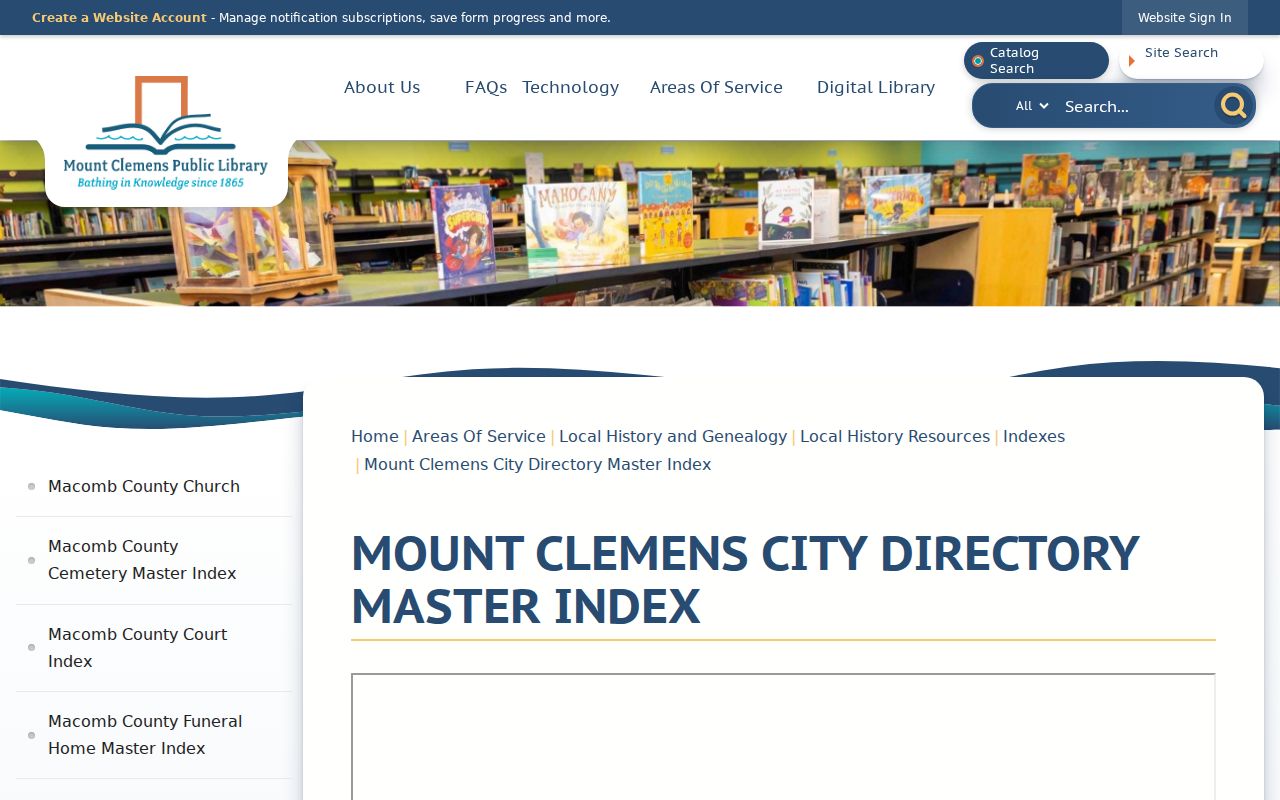
Use the index screen only as a locator. Preserve the title, year, page, and spelling from the underlying item in a research note.
Reading a Shelby Township City Directory Entry
A directory entry is a dated record of what one book chose to print. It supports a careful inventory. It does not support a reconstructed personal profile. Capture only fields on the page. A household, business, address, telephone, occupation, or cross-reference field may appear, and the mix differs between volumes. Never fill an absent field from memory or from a different year.
| Name as printed | Copy the surname, given name, initials, and punctuation without normalizing them. |
|---|---|
| Year and volume | Record the book title, directory year, and page or index reference. |
| Street line | Preserve the number, street name, township or city label, and any address variation. |
| Household or business label | Note it only if the page supplies one. |
| Occupation, telephone, or organization | Mark these as page-specific fields, if shown. |
| Cross-reference | Keep any printed “see” direction because it may lead to another spelling or listing. |
- Master index
- A name-and-year locator that directs the researcher to a source volume or page. It is not the complete directory page collection.
- Householder index
- A list organized around household names when a particular directory includes such a section. Confirm the volume's own arrangement before relying on it.
- Criss-cross directory
- An address- or street-ordered directory section in runs that include one. No local continuous Shelby criss-cross series was identified.
- Abbreviation key
- The printed explanation of shortened labels. Save it with the page citation because meanings can vary by volume.
Shelby Township Directory Cross-Checks
Mount Clemens Public Library offers more than one way to test a name from an old book. The Macomb County Cemetery Master Index lists local burials. A Funeral Home Master Index spans 227 volumes across 17 funeral homes. The obituary index reaches from 1941 to the present, with some older material. A Macomb Daily index runs from August 1994. Probate and court indexes, church and military indexes, a locally produced 1930 census index, and a Volunteer Fire Department index fill out the list. Mount Clemens High School yearbooks date from 1917.
These are separate evidence layers. A directory address, an obituary date, a funeral-home reference, and a cemetery transcription may all attach to one name while each answers a different question. Record the index type, title, and date. Add the page reference and institution. A missing result in one index is not proof the person was absent from the county or from Shelby Township.
Shelby Township City Directories Across Decades
Directory research rewards patience and sequencing in Shelby Township. Start with the year you already know. Then pull one volume earlier and one later. That simple widening can distinguish an actual move from a spelling change, a business listing, or a gap in the collection itself. Before pairing a book year with a census schedule, confirm that the address and the jurisdiction truly line up. Keep in mind that the library's 1930 census index is only a finding aid, while the original census record and the dated directory page remain two separate sources.
- Search the name in the master index and note every year returned, including spelling variants.
- Request or consult the matching volume or microfilm page and record the directory title, year, page, address, and printed labels.
- Follow the same name backward and forward through nearby years, keeping each address change in chronological order.
- Compare the year with an appropriate census source or the library's 1930 index, then retain the record type and date for each result.
- Use an obituary, cemetery, probate, newspaper, or yearbook index to test whether a disappearance may reflect a move, death, school connection, or an unlisted period.
A name that drops out of the Shelby Township residents directory can mean several things. The family may have moved away. Listing practices may have shifted, or the person may simply have been omitted. The entry might even belong to a different person with the same name, so preserve the uncertainty instead of assigning a reason without the underlying record.
Shelby Township Cemetery Names and Directory Gaps
A burial record can close a gap that a directory leaves open. Shelby Township counts seven historic cemeteries among its records. Utica Cemetery alone holds Thomas Squire's 1817 burial and 49 Civil War veterans. It remains in active use. When a name vanishes from a city directory after a given year, a marker transcription or cemetery index can carry the family line forward. A dated obituary or probate file helps, too.
Treat a burial record as proof of the burial itself: the cemetery, the stone, the date. It establishes no street address for any directory year. The township cemetery history gives the local background. The library's cemetery master index is a strong lead for further digging.
Note: Record family connections with the source date, page or marker reference, and the custodian that holds the record.
Shelby Township Directory Records in Mount Clemens
Shelby Township records run through township and county institutions rather than a city-clerk system. Macomb County's county-seat offices sit in Mount Clemens. So do the major local-history collections. A Shelby residents directory search can therefore lead to a Mount Clemens directory title. It can also point to a newspaper, archive guide, or library index. That geography is normal. It is not evidence that the historical subject ever lived in Mount Clemens.
- 1840-1864: Archives of Michigan identifies Shelby Township assessment rolls.
- 1875-1920: Heritage Alliance reports original Shelby Township rolls.
- 1896-1966: The Mount Clemens master index supplies a named directory research run.
- 1904 and 1944: Shelby maps add road and landscape context between roll and parcel records.
The Macomb County Heritage Alliance guide is a strong collection locator. It points to the Shelby Township rolls from 1875-1920 and the 1904 and 1944 maps. It also lists local-history books and Historical Society artifacts. Nothing there is presented as a complete online name database. Contact the identified holder first. Never assume a roll, map, vertical file, or artifact is ready for immediate searching.
Shelby Township City Directory Map Context
Older addresses get hard to recognize. A farm tract becomes a subdivision parcel. A road name changes. Follow the legal description instead. Trace the section, lot, block, or tract language across the 1840-1864 Shelby assessment rolls, the 1875, 1895, and 1916 plats, and the 1904 and 1944 township maps. Later recorded land records continue that trail. The Archives of Michigan Macomb County guide identifies the early Shelby assessment-roll series. It also provides the catalog and request route for originals or reproductions.
Mount Clemens Sanborn maps from 1903 and 1909 offer nearby urban context. They include building footprints and street names. No Shelby Township-specific Sanborn series exists. Treat those Mount Clemens sheets as context only, never as proof for a Shelby parcel. For a current address-to-parcel question, the modern record trail belongs with the township assessor. County GIS carries it from there. A historical street directory does not.